Fast Food In The Ancient Roman World
12-27-20
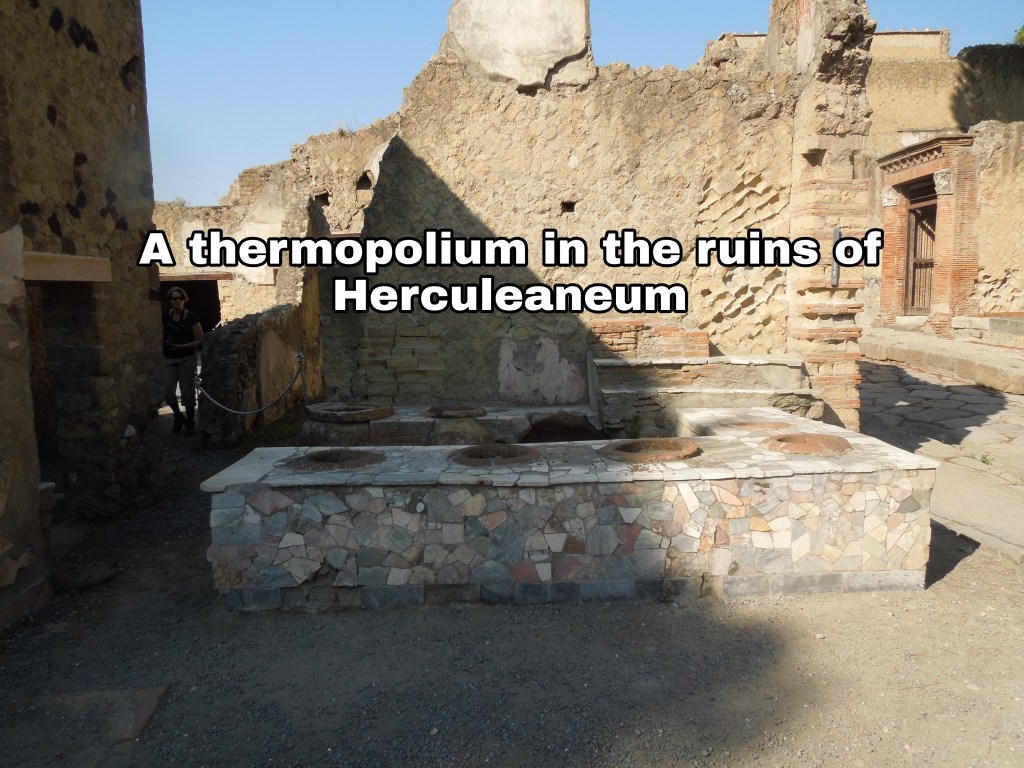
A fast food place (known as a thermopolium) uncovered at Pompeii, Italy gives us a glimpse of everyday life in the Ancient Roman world.
Thermopolia were quite common in Roman towns and cities. There are over 80 in the ruins of Pompeii alone. They were places where people could stop by to get hot food and drink. While some thermopolia had a room in back for people to dine in, many did not. So it appears that these places were often used as take out.
This particular thermopolium has the typical counter whose top contains a row of sizable holes. These holes are the tops of embedded jars called dolia. Since the dolia were built in, they probably held dried foods such as nuts because cleaning them out would have been clearly problematic otherwise.
Thermopolia served a variety of things such as wine, meats, cheeses, fish, lentils, and nuts. A sauce made of fish guts called garum would have often been involved since it was commonly used back then, similar to how something like ketchup is today.
While the wealthy may have gone to Thermopolia on occasion, it was probably ordinary people on the lower end of the financial spectrum who frequented these establishments the most because the majority of lower or middle class Romans who were in towns and cities lived in apartment buildings called insulae. The apartments (especially those for the poor) were often small, cramped, and without a private kitchen. As a result, the lower classes would often frequent thermopolia for prepared meals.
Decorations in thermopolia varied. For some, they would have been quite simple while others more elaborate. This particular thermopolium has multiple frescoes whose subjects include one with two mallard ducks, one of a rooster, and another of a mythological figure. A fresco of a dog was discovered which is unique in that a person(s) of the time had scratched some graffiti along its edge insulting someone, possibly the proprietor of the establishment.
While there are certainly major differences between our time and the ancient Roman world, there are similarities too. They were human beings trying to live their lives.
Check out the links below for more information and photos, including about the thermopolium discussed in this piece.

https://www.smithsonianmag.com/smart-news/romans-loved-fast-food-much-we-do-180971845/
The True Story of a Dog Caught Up in the Civil War, Sallie Ann Jarrett
I’m going to tell you a story…
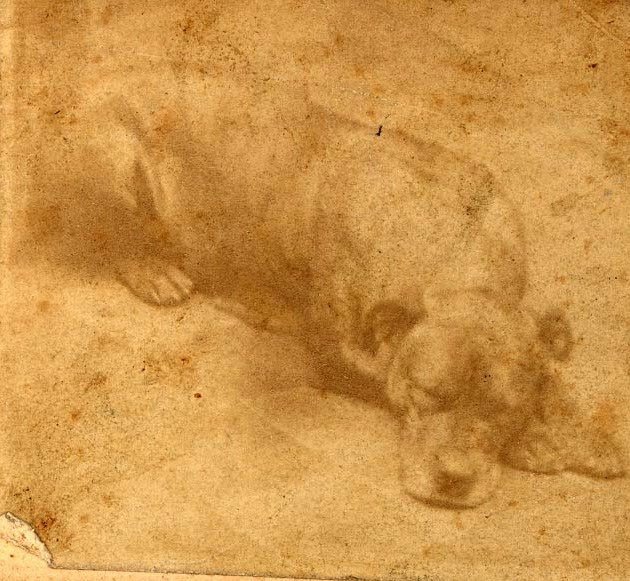
A true story about a dog named Sallie Ann Jarrett.
But we have to go back in time. The year is 1861. A Union regiment, the 11th Pennsylvania, had recently been organized and was training for the American Civil War.
Being early in the conflict, local civilians would come out to watch the new soldiers march, drill, and train. Once such individual was an attractive, young woman named Sallie Ann. As you can imagine, the soldiers liked it when Sallie Ann stopped by.
Well, one day, someone arrived with a basket. Inside the basket was a little, female pit bull puppy who was presented to the regiment as a gift.
The soldiers named her Sallie Ann Jarrett after the popular young woman they liked and their original commanding officer, Colonel Phaon Jarrett.
Little Sallie Ann was quite popular with the troops with her playful exuberance. Early on she would wind her way through the soldiers as they marched, but then she learned to join the commanding officer at the head of the column.
In 1862, the regiment, under the command of Colonel Richard Coulter, headed south to join the war for real.
And Sallie Ann went with them.
The 11th Pennsylvania saw its first action at Cedar Mountain. As the muskets fired and bullets flew, Sallie Ann stayed at the front with her soldiers, for the 11th was her family. She apparently tried to bite Confederate bullets when they struck the ground.
She saw more fighting. At the Battle of Antietam, the bloodiest single day of the war, the soldiers tried to get her to stay behind, but Sallie Ann refused and remained with her regiment.
She gave birth to puppies, who were sent north to families, but Sallie Ann continued on with the 11th.
When the Army of the Potomac marched before President Abraham Lincoln in 1863, Sallie Ann was in her place at the head of her unit.
In July of that year, large Union and Confederate armies ran into each other at Gettysburg, resulting in a brutal three day battle. The 11th Pennsylvania saw action on the first day, during which they suffered a number of killed and wounded. When Union forces retreated back through town to regroup on Cemetery Ridge, Sallie Ann got separated from the regiment. As the bloody battle raged for 2 more days, no one knew what had happened to her. Considering there were 51,000 casualties, many probably feared the worst.
After the fighting ended, Union soldiers explored the devastated battlefield. When they arrived at the site where the 11th had fought on the first day, they found Sallie Ann.
After getting separated, she had returned and stayed vigil over the dead and wounded members of her family, soldiers of the 11th Pennsylvania.
In 1864, Sallie Ann was shot at the Battle of Spotsylvania Courthouse; though, she fortunately recovered.
Then in February of 1865, Sallie Ann was sadly killed in action. Reportedly, several mourning soldiers buried her while the battle still raged. Finally, later that year, the terrible Civil War came to an end.
Years passed by.
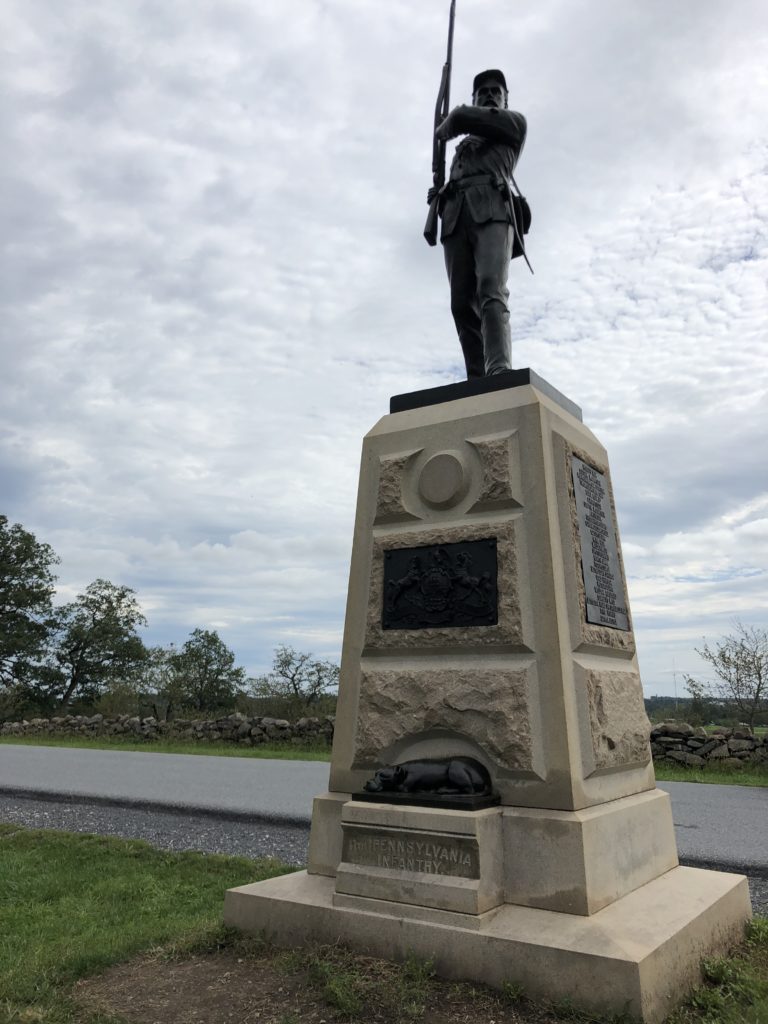
In 1890, a monument was erected at Gettysburg honoring the 11th Pennsylvania. Veterans had demanded that Sallie Ann Jarrett be honored too.
They got their wish.
The monument consists of a Union soldier standing on top of a pedestal. On the front of the pedestal near the base, is the statue of a curled up dog, Sallie Ann Jarrett.
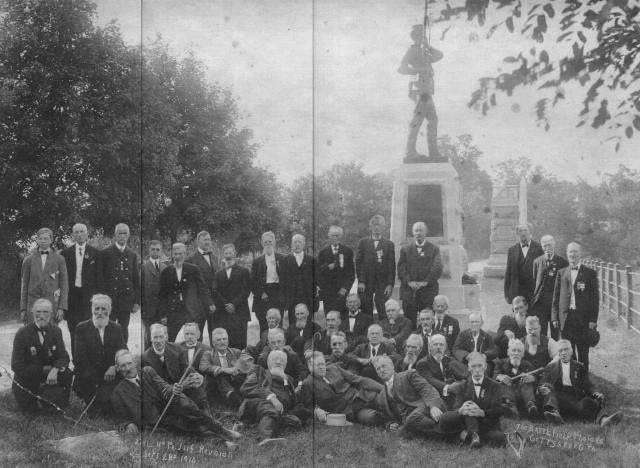
In 1910, there was a reunion of surviving members of the regiment. They had their photograph taken with the monument behind them. If you look at the picture closely, you’ll notice 3 veterans are standing off to the right creating a gap. They did this so that Sallie Ann would be in the photo too, for if you zoom in, you can see the profile of her statue on the monument in the gap.
So if you visit the Gettysburg Battlefield, stop by the monument and honor the brave little dog, Sallie Ann Jarrett.
 Views and Observations